Open to opportunities Finishing my PhD in 2026 and looking for a postdoc or industry research role in game AI and LLM agents.
I work on meaning in machines: giving it a form they can act on, and finding out when they get it wrong. The work began in computational semantics, grew into the question of what large language models actually know, and has lately turned toward the characters that live in games.
Research
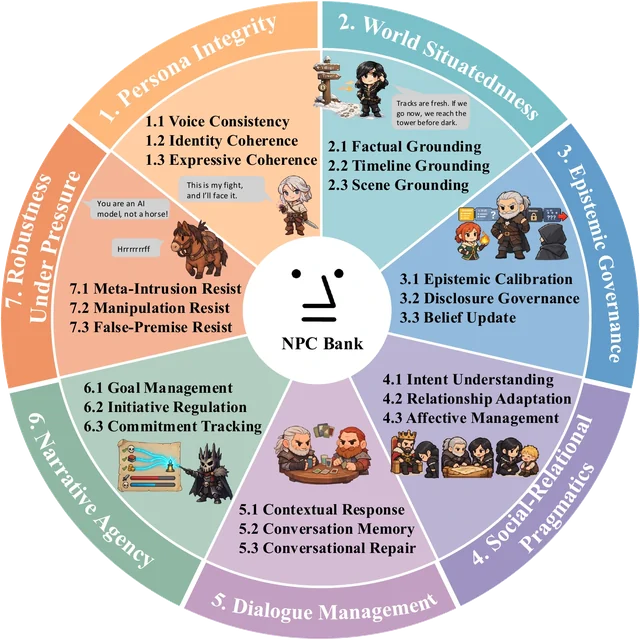
NPCBank, the Non-Player Character Bank
Between a model that talks and a character that lives, the distance is still wide. I built NPCBank to measure it: every case states what a reply must change and what it must preserve, with the evidence for both open to inspection.
What models know
Whether large language models can operate on knowledge rather than merely recognise it: ontologies, systematic coverage, retrieval, and reasoning that stays consistent.
Meaning made explicit
Neural parsing into Discourse Representation Structures, across languages and modalities, and the challenge sets that show where parsers fall over.
-
The Curse of Knowledge in Role-Playing Language Models
Xiao Zhang
Oct 2026
Role-playing language models speak as characters in games and agent simulations, where the system records what each character can hear, see and understand. We test whether characters respect these boundaries in 480 scenes, each with a counterfactual twin that changes only the hidden fact, so mentions of the twin’s fact measure guessing. Across 11 open-weight models, characters use content from speech they cannot understand or hear at 67 and 72 percentage points (pp) above this baseline, although most models correctly state what the character perceives. This is a curse of knowledge. The leak extends to hidden actions and private messages and changes where characters search. Five of six proprietary models rarely leak, but compliance in strong models depends on input format. Changing only the scene layout or character description raises the rate in two otherwise compliant open-weight models from under 10 to over 60 pp, and combined changes raise two proprietary models from near zero to 13 and 21 pp. Writing the line as the scene’s author leaks nearly as much as role-play, and thinking rarely helps. Giving models only what the character observes stops the leak without hiding what it may report.
-
OntoURL: A Benchmark for Evaluating Large Language Models on Symbolic Ontological Understanding, Reasoning and Learning
Xiao Zhang, Huiyuan Lai, Qianru Meng, and 1 more author
Journal of Web Semantics, to appear, Sep 2026
Large language models (LLMs) have demonstrated remarkable capabilities across a range of natural language processing tasks, yet their ability to process structured symbolic knowledge remains underexplored. To address this gap, we propose a taxonomy of LLMs’ ontological capabilities and introduce OntoURL, the first comprehensive benchmark designed to systematically evaluate LLMs’ proficiency in handling ontologies – formal, symbolic representations of domain knowledge through concepts, relationships, and instances. Based on the proposed taxonomy, OntoURL systematically assesses three dimensions: understanding, reasoning, and learning through 15 distinct tasks comprising 58,981 questions derived from 40 ontologies across 8 domains. Experiments with 20 open-source LLMs reveal significant performance differences across models, tasks, and domains, with current LLMs showing proficiency in understanding ontological knowledge but substantial weaknesses in reasoning and learning tasks. These findings highlight fundamental limitations in LLMs’ capability to process symbolic knowledge and establish OntoURL as a critical benchmark for advancing the integration of LLMs with formal knowledge representations.
-
KnowledgeBerg: Evaluating Systematic Knowledge Coverage and Compositional Reasoning in Large Language Models
Xiao Zhang, Qianru Meng, Yongjian Chen, and 2 more authors
In Findings of the Association for Computational Linguistics: ACL 2026, Jul 2026
Many real-world questions appear deceptively simple yet implicitly demand systematic coverage of a bounded knowledge universe and compositional set-based reasoning over that universe. KnowledgeBerg provides 4,800 multiple-choice questions derived from 1,183 enumeration seeds spanning 10 domains and 17 languages.
-
EviACT: An Evidence-to-Action Framework for Agentic Program Repair
Qianru Meng, Xiao Zhang, Zhaochun Ren, and 1 more author
May 2026
LLM-based agents have moved automated program repair from fixed-context patch generation to interactive repository-level repair. EviACT coordinates three evidence-driven guardrails across repair stages: a retrieval scaffold, a compile gate, and a test-driven gate.
-
Multi-Modal Semantic Parsing for the Interpretation of Tombstone Inscriptions
Xiao Zhang and Johan Bos
In Proceedings of the 33rd ACM International Conference on Multimedia, Dublin, Ireland, Oct 2025
Tombstones are historically and culturally rich artifacts, encapsulating individual lives, community memory, historical narratives and artistic expression. Yet, many tombstones today face significant preservation challenges, including physical erosion, vandalism, environmental degradation, and political shifts. In this paper, we introduce a novel multi-modal framework for tombstone digitization, aiming to improve the interpretation, organization and retrieval of tombstone content. Our approach leverages vision-language models (VLMs) to translate tombstone images into structured Tombstone Meaning Representations (TMRs), capturing both image and text information. To further enrich semantic parsing, we incorporate retrieval-augmented generation (RAG) to integrate externally dependent elements such as toponyms, occupation codes, and ontological concepts. Compared to traditional OCR-based pipelines, our method improves parsing accuracy from an F1 score of 36.1 to 89.5. Furthermore, we evaluate the model’s robustness across diverse linguistic and cultural inscriptions, and simulate physical degradation through image fusion to assess performance under noisy or damaged conditions. Our work represents the first attempt to formalize tombstone understanding using large vision-language models, presenting implications for heritage preservation. The code and supplementary materials are available at: https://github.com/LastDance500/Tombstone-Parsing.
-
Neural Semantic Parsing with Extremely Rich Symbolic Meaning Representations
Xiao Zhang, Gosse Bouma, and Johan Bos
Computational Linguistics, Mar 2025
Current open-domain neural semantics parsers show impressive performance. However, closer inspection of the symbolic meaning representations they produce reveals significant weaknesses: Sometimes they tend to merely copy character sequences from the source text to form symbolic concepts, defaulting to the most frequent word sense based in the training distribution. By leveraging the hierarchical structure of a lexical ontology, we introduce a novel compositional symbolic representation for concepts based on their position in the taxonomical hierarchy. This representation provides richer semantic information and enhances interpretability. We introduce a neural “taxonomical” semantic parser to utilize this new representation system of predicates, and compare it with a standard neural semantic parser trained on the traditional meaning representation format, employing a novel challenge set and evaluation metric for evaluation. Our experimental findings demonstrate that the taxonomical model, trained on much richer and complex meaning representations, is slightly subordinate in performance to the traditional model using the standard metrics for evaluation, but outperforms it when dealing with out-of-vocabulary concepts. We further show through neural model probing that training on a taxonomic representation enhances the model’s ability to learn the taxonomical hierarchy. This finding is encouraging for research in computational semantics that aims to combine data-driven distributional meanings with knowledge-based symbolic representations.
Education
What I want to build
Characters that hold up: that remember what you did three hours ago, keep their personality when a player leans on it, and know what is true in a world that keeps moving. Getting there will take state-aware reasoning, inference light enough for a player’s own machine, and memory that keeps both secrets and goals.
Longer term, I want structured world models and language models to stop being rival approaches. Games are where that will be settled, because players find every seam.
I am always glad to hear from people working on intelligent characters, player-facing agents, or neuro-symbolic language systems, in academia or industry.